A Wheelchair is Your Second Skin. Let a Doctor Prescribe It.
Buying a standard hospital wheelchair off the shelf is like wearing someone else's shoes for 12 hours a day—it causes severe pain, spinal deformities, and life-threatening bed sores. For individuals with complex neurological or physical limitations, a wheelchair is not just a chair; it is a vital medical orthotic.
Message Us to Book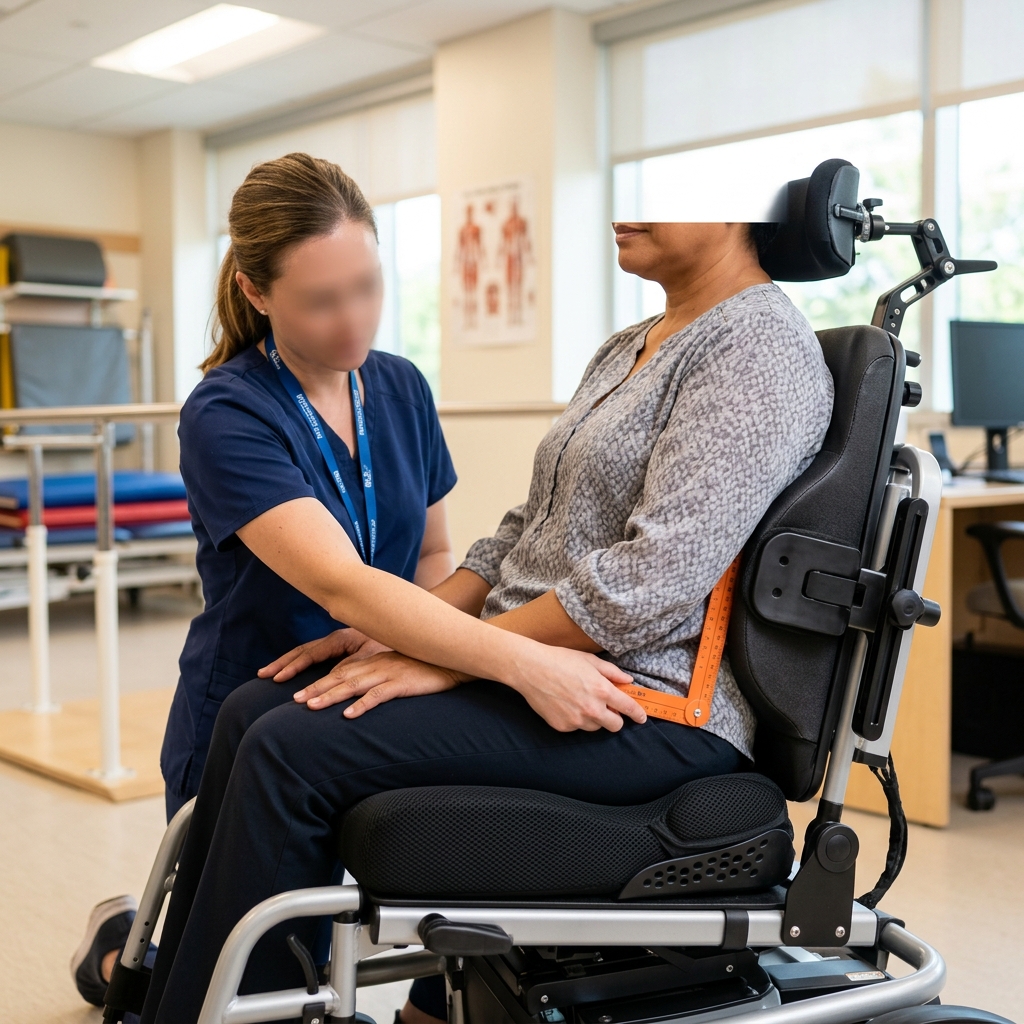
The Danger of the 'One-Size-Fits-All' Chair
When a family member suffers a stroke or spinal cord injury, the immediate reaction is often to rush to a pharmacy and buy the first generic folding wheelchair available. This is a critical medical error. Standard sling-seat wheelchairs are designed for temporary transport (like moving a patient from a hospital room to a car). They are absolutely not designed for long-term daily living. Sitting in a generic chair for hours causes the pelvis to tilt backward, collapsing the spine into a 'C' shape. This postural collapse crushes the internal organs, making breathing and digestion difficult, and places catastrophic friction on the tailbone, inevitably leading to severe pressure ulcers (bed sores).
Practitioner's Insight: When treating local patients for severe decubitus ulcers (bed sores) in our Vigan City clinic, we almost always trace the root cause back to a poorly fitted wheelchair. A medical supply salesman’s goal is to sell you the inventory they have in stock. As a Board-Certified Physiatrist, my goal is to protect your skin integrity and skeletal alignment. A true custom wheelchair is a highly advanced medical orthotic. We meticulously assess your muscle spasticity, pelvic obliquity, and skin health to prescribe a custom seating system that actively distributes your weight, aligns your spine, and maximizes your ability to interact with the world.
Who Needs a Clinical Seating Assessment?
Is This Right for You?
You are an EXCELLENT candidate if:
- You find yourself constantly sliding forward out of your wheelchair and needing caregivers to pull you back up.
- You are leaning heavily to one side, causing back pain or breathing difficulties.
- You have developed redness, blisters, or open wounds (sugat sa likod) on your tailbone, hips, or heels.
- Your current manual wheelchair is too heavy to propel, destroying your shoulder joints in the process.
- You require a transition to an electric/motorized wheelchair to maintain your independence.
You may NOT be a candidate if:
- You only require a wheelchair for extremely brief, temporary transport (e.g., a 15-minute trip from the car to a doctor's waiting room) and are fully capable of walking otherwise. In such cases, a basic transport chair is sufficient.
The Pharmacy Store vs. The Physiatrist
Sling seat made of cheap vinyl that stretches out over time, pulling the hips together. Extremely heavy frames. No pelvic support. Actively promotes scoliosis and bed sores.
Features slightly better padding or a 'gel' cushion bought off the internet. Guesswork. You are buying an expensive cushion without knowing if it matches your specific pelvic tilt or orthopedic needs. A good cushion on a bad frame still fails.
A physician measures your exact joint angles, skin risk, and neurological tone. The chair frame, cushion, backrest, and wheels are ordered individually to construct a perfectly fitted orthotic environment.
Timeline & Expected Outcomes
MAT Assessment
60-90 minute comprehensive physical analysis to determine structural requirements.
Trial & Fitting
Testing various cushions and backrests to finalize the prescription.
Independence
Maximized comfort, skin protection, and functional mobility in the community.
Clinical Science & Technical Details
For our medical colleagues and highly analytical patients, we provide these transparent technical details on the pathophysiology and interventional protocols.
Explore the Clinical Science: Pelvic Obliquity and Interface Pressure
The core objective of clinical wheelchair seating is the management of interface pressure and the stabilization of the pelvis. The pelvis serves as the biomechanical foundation for the entire seated posture. In a standard sling wheelchair, the hammock effect forces the femurs into internal rotation and the pelvis into a severe posterior pelvic tilt. This shifts the patient's center of gravity directly onto the sacrum and coccyx—areas with minimal subcutaneous tissue—creating extreme interface pressure and shear forces that rapidly occlude capillary blood flow, resulting in ischemic tissue necrosis (pressure ulcers). Our clinical seating assessment utilizes firm, contoured bases and highly specialized materials (like viscoelastic foam or ROHO air-cell cushions) to maintain a neutral or font-weight: 500; anterior pelvic tilt. This deliberately shifts the weight-bearing load onto the ischial tuberosities and posterior thighs, safely distributing the force over a vast surface area and neutralizing shear.
Detailed Diagnostic Pathways: The MAT Assessment
At TeraCare, prescribing a wheelchair begins outside of the chair. Dr. Rabara performs a comprehensive Mechanical Assessment Tool (MAT) evaluation. The patient is first assessed in a supine position (lying down) on a clinical mat to eliminate the influence of gravity. This allows the clinician to differentiate between fixed orthopedic deformities (which the wheelchair must accommodate) and flexible postural asymmetries (which the wheelchair seating system must actively correct). We measure hamstring length, hip flexion limits, and spinal mobility. Only by establishing these baseline biomechanical parameters can we accurately specify the required seat-to-back angle, footrest hanger angle, and lateral thoracic supports required to achieve optimal seating.
Advanced Systemic Screening: Skin Integrity and Sensation
The most critical risk factor evaluated during a seating clinic is the patient's insensate skin (lack of physical sensation). Patients with complete spinal cord injuries or severe diabetic neuropathy cannot feel the ischemic pain that normally prompts a healthy individual to shift their weight. Without this biofeedback mechanism, catastrophic stage III or IV pressure ulcers can develop in a matter of hours. During the assessment, Dr. Rabara evaluates the patient's pressure relief capabilities (e.g., can they perform a wheelchair push-up, or do they require a power-tilt-in-space mechanism?). The seating prescription is then engineered entirely around mitigating these specific dermatological and vascular risks.
Inside the Procedure: Power Mobility and Alternative Drive Controls
For patients presenting with severe neuromuscular conditions (such as ALS or high-level cervical spinal cord injuries) who lack the upper extremity strength to propel a manual chair or use a standard joystick, Dr. Rabara's assessment expands into Complex Rehab Technology (CRT). We evaluate the patient's remaining voluntary motor control to prescribe alternative drive systems. This may involve sip-and-puff mechanisms, head-array switches, or chin controls. Additionally, the assessment will dictate the necessity of power positioning features—such as power tilt-in-space, power recline, or elevating leg rests—which are medically vital for patients who cannot independently manage their own weight shifts to prevent pressure injuries.
The Journey to Your Custom Chair
Step 1: The Clinical Interview & Goal Setting
We sit down with you and your caregivers. What are your daily goals? Do you need a lightweight chair to fit in a small car? Do you need an electric motorized wheelchair to navigate the terrain in Northern Luzon? We assess your home environment and daily activities.
Step 2: The MAT Assessment (Physical Exam)
We move you to a clinical examination mat. Dr. Rabara measures your hip flexibility, spine alignment, and muscle tone without the interference of gravity. We identify any fixed skeletal deformities that the chair must accommodate, and flexible postures that the chair must correct.
Step 3: Simulation & Equipment Trials
We mock up different seating angles and trial various pressure-relief cushions (like ROHO, Jay, or custom-molded foam). We ensure that the selected backrest provides optimal lateral support to prevent you from leaning, keeping your airway and digestion unrestricted.
Step 4: The Medical Prescription & Fitting
Dr. Rabara writes a comprehensive medical prescription for the exact dimensions, cushion type, and frame style required. Once the equipment arrives, you return to the clinic for a final delivery fitting to ensure the chair acts as a flawless 'second skin.'
Common Questions
Magkano ang wheelchair price sa Pilipinas, at sulit ba ang custom?
A generic wheelchair can be bought for a few thousand pesos, but it is a false economy. The medical cost of treating a single severe bed sore—requiring hospitalization, antibiotics, and plastic surgery—can easily exceed hundreds of thousands of pesos. Investing in a clinical seating assessment and a custom ergonomic wheelchair prevents these catastrophic complications, making it a highly cost-effective medical decision.
Paano gamutin ang bed sores (decubitus ulcers)?
Creams and dressings will never heal a bed sore if you keep sitting on the same generic wheelchair that caused it. The true treatment for bed sores is absolute pressure offloading. When treating local patients for pressure ulcers, our first step is removing them from their generic chair and prescribing a specialized, medical-grade pressure relief cushion (like air-cell technology) fitted to an ergonomic frame to stop the friction at the source.
What is the difference between a standard electric wheelchair and a custom power chair?
A standard motorized wheelchair bought online has a generic, flat seat. A custom power chair prescribed by our clinic features customized seating (contoured backrests, specific seat depth) and specialized electronics. We program the joystick's sensitivity to match your hand strength and can include 'tilt-in-space' functions that tilt the entire chair backward to relieve pressure off your spine throughout the day.
Can a stroke patient get an assessment for a specialized wheelchair?
Yes, this is highly recommended. Stroke patients often suffer from hemiplegia (weakness on one side of the body). If placed in a standard chair, they will continuously lean and slide to their weak side. Our seating clinic will prescribe a chair with targeted lateral (side) supports, a specialized cushion to lock the pelvis in place, and a lower seat-to-floor height so the patient can use their strong leg to safely propel the chair.
Do you provide PhilHealth or HMO coverage for wheelchair assessments?
The clinical evaluation (the MAT assessment) conducted by Dr. Rabara is a specialized physiatric consultation, which may have partial coverage depending on your specific HMO or PhilHealth standing. The physical hardware (the custom wheelchair frame and medical cushions) are typically out-of-pocket medical equipment investments. We provide full transparency on the assessment fees prior to your appointment.