Overcome Your Injury. Dominate Your Sport Again.
Don't let an injury sideline your active lifestyle. From weekend warriors to competitive athletes, our functional sports medicine protocols rebuild your biomechanics and aggressively, yet safely, return you to play.
Message Us to Book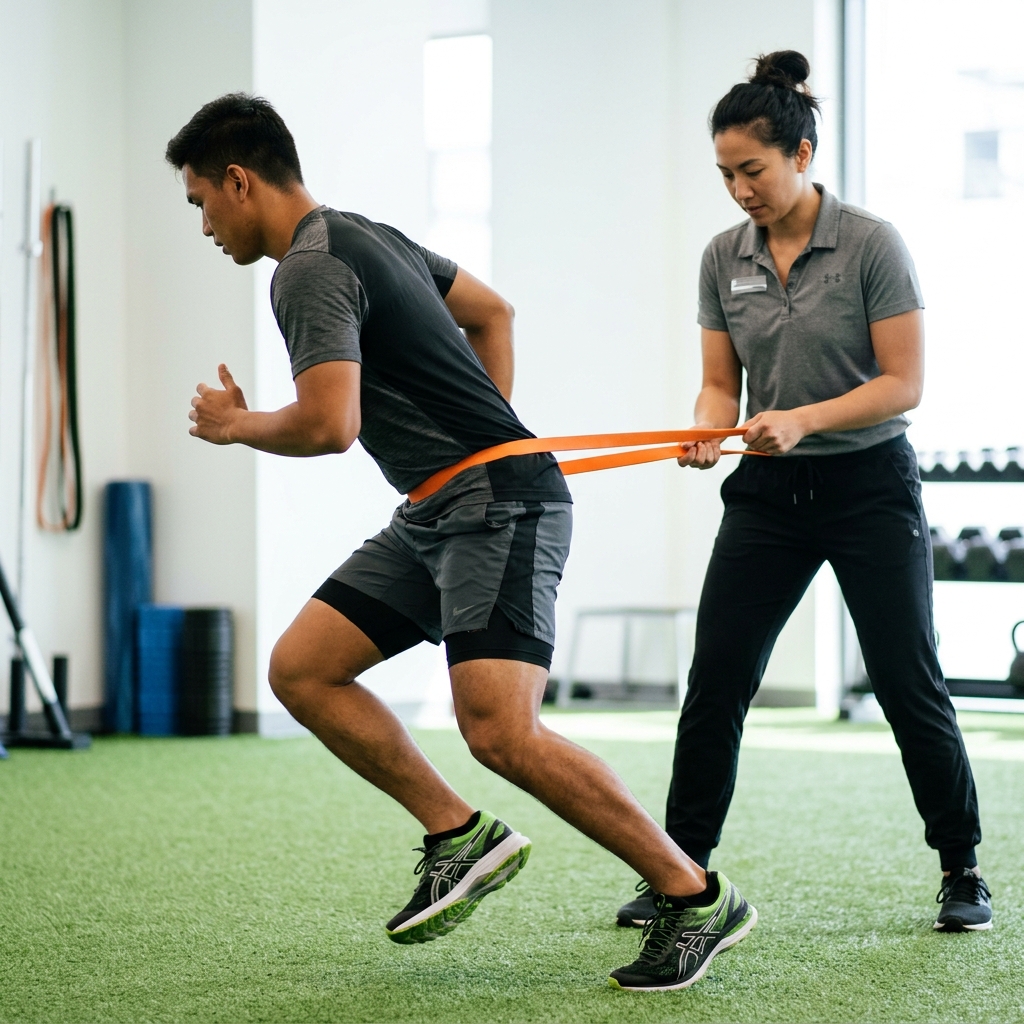
The Science of the Comeback
When an athlete suffers an injury, the most frustrating advice they can receive is, "Just rest it for six weeks." While initial tissue protection is critical, prolonged rest actually causes muscles to atrophy, tendons to weaken, and joints to stiffen. Standard medical care stops when the pain goes away. Sports Medicine goes much further. Our goal is not just a pain-free joint; our goal is a joint that can withstand the explosive forces of running, jumping, and cutting without re-injury.
TeraCare bridges the gap between the medical clinic and the playing field. Dr. Rabara designs periodized, physician-led rehabilitation blueprints tailored to your specific sport. Whether you are recovering from an acute ACL tear or battling chronic runner's knee, we utilize advanced orthopedic physical therapy protocols to identify the biomechanical flaws that caused the injury and correct them, ensuring your comeback is stronger than your setback.
Athletic Injuries We Rehabilitate
Is Sports Medicine Right For You?
You do not need to be a professional athlete to benefit from sports medicine. If your goal is to return to an active, pain-free lifestyle, this is the appropriate clinical pathway.
Good Candidate If:
- Injury sustained at the gym, on the court, or during a run failing to heal.
- Preparing for or recovering from orthopedic surgery (ACL, Rotator Cuff).
- Chronic pain occurring only during specific athletic movements (throwing, squatting).
- Transitioning from basic PT back to heavy weightlifting or high-impact sports.
Not a Candidate If:
- Acute, severe fracture requiring immediate surgical casting or pinning.
- Goal is generalized relaxation or spa-style massage rather than active recovery.
- Unmanaged system instability prevents high-intensity exertion.
The Realities of Returning to Play
Sports rehabilitation requires dedication, sweat, and a willingness to step outside your comfort zone. We believe in setting transparent clinical expectations:
- The Danger of Rushing: The leading cause of sports injuries is previous injuries. Returning too early increases re-injury risk drastically.
- It Will Be Challenging: Late-stage rehab mimics your sport. You will jump, cut, and lift under supervision, experiencing healthy muscle fatigue.
- Load Management: Recovery is not a straight line. We teach you how to manage training loads, knowing when to push and when to recover.
How Does Sports Rehab Differ?
Generic Physical Therapy
Focus: Basic daily living activities (walking, stairs).
Discharge: Full range of motion and no pain while resting.
Best For: Minor, uncomplicated sprains.
Precision Sports Medicine
Focus: High-velocity athletic performance (sprinting, jumping).
Discharge: Passing rigorous "Return-to-Play" tests proving 1:1 strength symmetry.
Best For: Athletes and active individuals requiring explosive recovery.
Passive Recovery
Focus: Ice, rest, and hope.
Discharge: Once the initial swelling goes down.
Best For: Very minor bruises or one-off acute strains.
In-Depth Clinical Science
Explore the Clinical Science: Mechanotransduction and Tissue Capacity
Core philosophy is rooted in Mechanotransduction—converting mechanical loading into cellular responses. Injured tissues require specific, progressive loads to heal; under-loading causes fibrotic weakness. We find the "Goldilocks zone" for loading. For tendinopathies, we implement heavy slow resistance (HSR) and eccentric protocols to stimluate Type I collagen alignment. We evaluate the entire kinetic chain—addressing remote biomechanical deficits (like hip mobility for elbow pain) to permanently elevate tissue capacity and reduce re-injury probability.
Detailed Diagnostic Pathways for Sports Pathology
For multidirectional athletes (basketball, tennis), ACL or ankle sprains require neuromusclular control training. We focus on deceleration mechanics and landing kinematics (preventing knee valgus). For overhead athletes (volleyball, baseball), we assess scapular dyskinesia—retraining the serratus anterior and lower trapezius to upwardly rotate the scapula, mechanically opening the subacromial space to eliminate impingement without surgery.
Advanced Systemic & Post-Surgical Contraindications
We maintain strict communication with operating surgeons, adhering flawlessly to Weight-Bearing and ROM restrictions to protect grafts and meniscal sutures. Absolute contraindications include acute systemic infections, undiagnosed joint effusions (requiring aspiration), or suspected DVT. If neurogenic pain is present, we may deploy PIT or Dry Needling to extinguish inflammation before loading the kinetic chain.
The Psychology of Injury and Kinesiophobia
A crucial component is psychological rehab. Athletes frequently develop Kinesiophobia (fear of re-injury). By utilizing objective data—force plate analysis, Isokinetic strength ratios (Hamstring:Quad), and hop tests—we provide mathematical proof of capability. Passing these rigorous benchmarks restores confidence, allowing instinctive rather than protective play.
Integrating Interventional Physiatry into the Rehab Pathway
Being physician-led allows us to deploy medical interventions (Dry Needling, Orthobiologics) if therapy stalls. If an athlete develops limiting inflammation, we don't send them back to a surgeon; we treat it in-house immediately. This integration eliminates delays and accelerates the healing timeline, keeping the athlete active throughout the process.
Energy System Development During Rehabilitation
Neglecting conditioning leads to post-clearance fatigue and secondary injury. We implement modified cardiovascular protocols (upper-body ergometers, aquatic therapy, BFR training) to maintain aerobic and anaerobic baseline during downtime. This ensures that when the joint is cleared, the athlete's motor is ready to perform.
The 3 Phases of Athletic Recovery
Acute Phase (Protect & Activate)
Focus on controlling swelling. We use manual therapy to reduce pain and teach activation of surrounding muscles without stressing the injured tissue.
Strength Phase (Load & Build)
Focus on hypertrophy and force production. We introduce heavier weights and resistance to rebuild the muscle mass and endurance lost during downtime.
Power Phase (Speed & Agility)
Focus on sport-specific dynamics. Transition to explosive plyometrics, lateral cutting, and reaction drills to prepare the nervous system for competition.
Don't Let an Injury End Your Season. Start Your Comeback.
The Return-to-Play Process
Biomechanical Evaluation
Dr. Rabara analyzes your movement patterns, strength deficits, and joint stability to identify why the injury occurred and build your custom blueprint.
Progressive Tissue Loading
You work with our therapists to gradually increase the stress on your healing tissue, transitioning from basic isolation exercises to complex, full-body movements.
Objective Return-to-Play Testing
Before you are cleared for the field, you must pass a battery of grueling, sport-specific physical tests to mathematically prove your body is ready for competition.
Common Questions
How do I know when I am ready to return to my sport?
We do not guess. You must pass a battery of objective Return-to-Play (RTP) tests, including strength symmetry and hop tests. Your injured limb must perform at 90% or higher capacity compared to your healthy limb before medical clearance.
I am not a competitive athlete; I just want to run pain-free. Is this for me?
Absolutely. Sports Medicine applies to any active person. Our goal is to analyze how you move, correct the flaws, and build the strength necessary for you to enjoy your hobbies without pain.
Can I still lift weights while I am in rehab?
In most cases, yes! We strongly encourage continuing to train the uninjured parts of your body. Maintaining overall fitness is excellent for your mental health and accelerates systemic recovery.
Why do I need to see Dr. Rabara before starting sports rehab?
As a Board-Certified Physiatrist, Dr. Rabara utilizes medical diagnostics to pinpoint the exact structural failure, ensuring your rehabilitation targets the actual problem, not just the symptoms.
Is Sports Rehabilitation covered by my insurance or PhilHealth?
Medically necessary physical therapy—especially after surgery or severe sprains—is frequently eligible for coverage. We will help you navigate your benefits.