Stabilize the Spine. Stop the Agony. Heal Correctly.
A flimsy drugstore belt will not protect a broken back. We provide rigid, custom-molded 'external skeletons' that lock the spine into position, providing instant mechanical pain relief and protecting your recovery.
Message Us to Book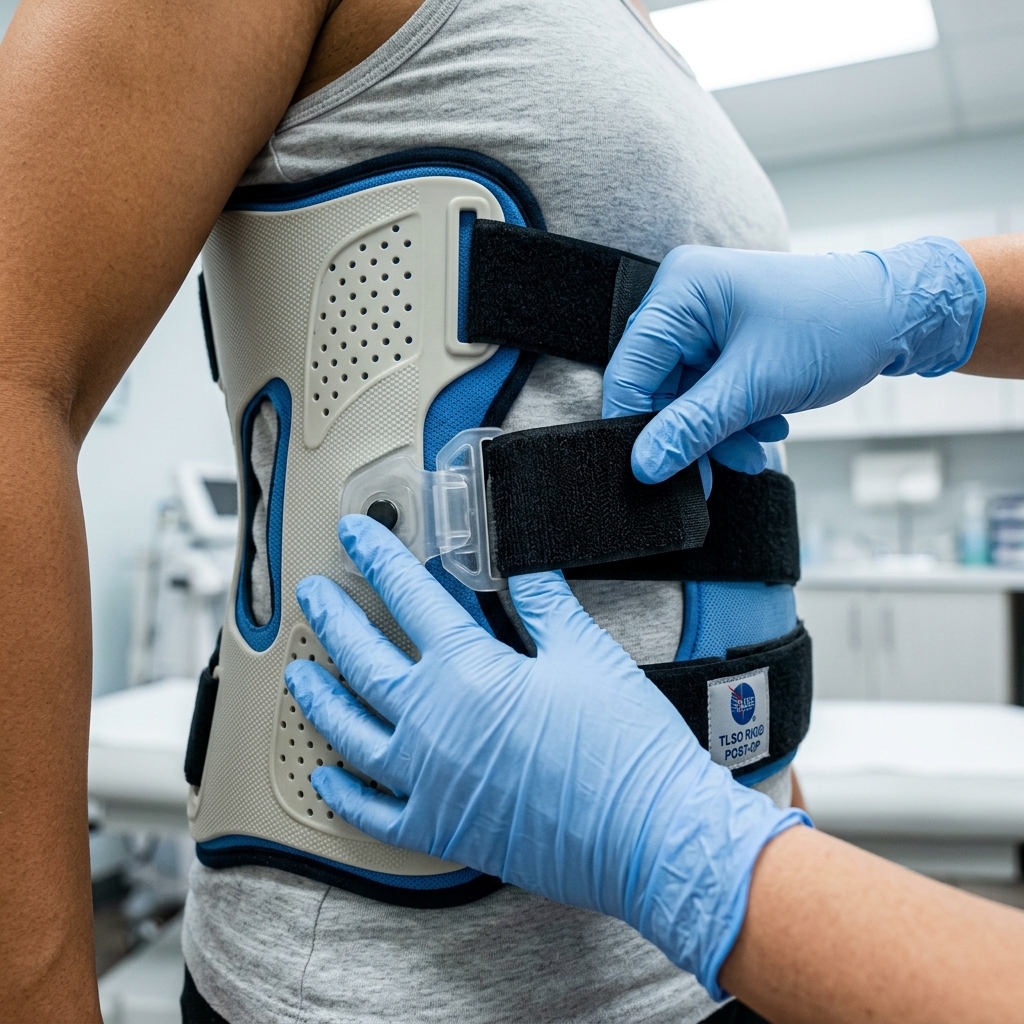
The Difference Between a Belt and an 'External Skeleton'
When a vertebra fractures due to osteoporosis or severe trauma, the pain is blinding. Every time the patient breathes, coughs, or attempts to sit up, the broken bone shifts slightly. These micro-movements cause agonizing pain and risk further collapse of the spine. The instinct is to rush to a pharmacy for an elastic back belt. However, a soft neoprene belt acts merely as a warm hug; it does absolutely nothing to stop broken bones from grinding together.
To heal a broken back or protect a spinal fusion, you need an "external skeleton." At TeraCare, we prescribe and coordinate the fabrication of rigid Spinal Orthotics (such as TLSO or Jewett braces). These devices are crafted from high-density thermoplastics and aerospace alloys to physically offload gravity from the fractured bone. By mechanically locking the spine into a neutral posture and stopping all micro-movements, the brace acts as a powerful non-medicated painkiller, allowing the patient to stand and walk safely while the bone heals.
Spinal Pathologies Requiring Rigid Bracing
Do You Need a Medical-Grade Spinal Brace?
You are an EXCELLENT candidate if:
- Sudden, agonizing back pain in an elderly parent (indicative of compression fracture).
- You were recently discharged after spinal surgery and require hardware protection.
- You have diagnosed spinal instability (like spondylolisthesis) that makes walking unsafe.
- You have a structural vertebral fracture confirmed via X-ray or MRI.
You may NOT be a candidate if:
- You have a minor muscle strain or 'tweaked' your back at the gym.
- No structural fracture or surgical instability is present.
- Mechanical back pain that responds well to standard physical therapy.
The Realities of Wearing a Spinal Orthosis
A medical back brace is a serious structural intervention. We believe in setting clinical expectations for the recovery journey:
- Kinematic Restriction: The brace will prevent you from bending, twisting, or slouching. This restriction is precisely what allows the fracture to heal in alignment.
- Skin Integrity: In the Philippine heat, moisture-wicking undershirts are mandatory beneath the brace to prevent pressure-relate skin irritation.
- Controlled Weaning: We avoid permanent muscle weakness by using a strict, physician-guided weaning protocol to rebuild your core strength safely as the bone heals.
Belts vs. Medical Orthotics
A soft, stretchy fabric belt. Provides zero structural immobilization or vertebral offloading.
Dr. Rabara prescribes specific biomechanical vectors for custom-molded rigid polymer braces (TLSO/Jewett).
The Timeline for Spinal Fracture Healing
Absolute Immobilization
The bone is fragile. The brace must be worn at all times when out of bed to prevent vertebral collapse and agonizing pain.
Biological Callous Phase
The body is creating new bone. Pain decreases, but the brace remains mandatory to prevent the new bone from snapping during remodeling.
The Weaning Process
We confirm healing via X-ray and slowly reduce brace hours while ramping up physical therapy to restore core strength.
Clinical Science & Technical Details
For our medical colleagues and highly analytical patients, we provide these transparent technical details on the pathophysiology and interventional protocols.
Explore the Clinical Science: Kinematic Restriction and Axial Offloading
The biomechanical efficacy of a rigid spinal orthosis relies on triplanar kinematic restriction and axial offloading utilizing a 3-point pressure system. A rigid TLSO (Thoracolumbosacral Orthosis) applies force vectors to maintain hyperextension.
This specifically opens the anterior vertebral space, unweighting the fractured vertebral body and transferring the axial load to the intact posterior elements (facet joints), facilitating osteoblastic activity in the fracture site.
Detailed Diagnostic Pathways: Stable vs. Unstable Spinal Trauma
Our orthotics prescriptions are rooted in the Denis three-column classification. An anterior wedge compression fracture involving only the anterior column is typically stable and managed with a hyperextension brace.
Conversely, burst fractures compromising the anterior and middle columns are neurologically unstable emergencies requiring rigid TLSO intervention or immediate surgical stabilization.
Advanced Systemic Screening: Skin Integrity & Pressure Management
Elderly patients possess highly friable skin. An axial-loading rigid brace can cause rapid ischemia or pressure necrosis over bony prominences if poorly fitted. We prioritize thermoplastic contouring and medical-grade liners.
Through our orthotics partnership, every brace is meticulously Flare-trimmed around the iliac crests and sternal notch to ensure structural support doesn't compromise skin health.
Clinical Recovery Protocols: Wolff's Law and Weaning Timelines
Spinal healing is governed by Wolff's Law. During the bony callus phase (Weeks 4-8), we maintain rigid protection. During the remodeling phase (Weeks 8+), we introduce controlled mechanical stress.
Our weaning protocol involves systematically reducing daily wear-time while ramping up supervised isometric stabilization exercises to align trabecular bone growth and prevent disuse atrophy of the paraspinal muscles.
Our Seamless Orthotic Pathway
Structural Diagnosis
Dr. Rabara reviews X-rays/MRIs to map the fracture typology and writes a precise biomechanical prescription for the brace.
Precision fitting
We coordinate with elite orthotics labs for advanced scanning or casting, ensuring the brace distributes pressure flawlessly over your body.
Log-Roll & ADL Training
We teach you how to wear the brace and safely perform daily activities (Log-rolling) to protect your spine while the bone callouses.
Common Questions
Do I have to wear the brace while I sleep?
This depends on the fracture stability. For compression fractures, you may be allowed to remove it while lying flat in bed. For post-op cases, sleeping in the brace or log-rolling techniques may be strictly required.
Will wearing a brace make my back muscles weak?
Temporary atrophy is expected, similar to a cast on an arm. However, we prevent permanent weakness through a structured, physician-led weaning and rehab protocol to rebuild your 'internal corset'.
Can I shower with the brace on?
If absolute immobilization is required, we teach safe sponge-bathing protocols. If you are allowed a brief 'off-time,' you may shower sitting on a waterproof chair with strict movement precautions.
Is it covered by PhilHealth or standard HMOs?
Because rigid orthotics are classified as Durable Medical Equipment (DME) for fractures, they are often eligible for coverage. Our team provides the necessary medical abstracts for your claims.
A pharmacy brace keeps digging into my hips. Can you fix it?
Yes. Generic braces often fit poorly. We coordinate with Prosthetists to reshape and re-pad medical braces to fit your unique anatomy properly.