Locate the Nerve. Interrupt the Signal. Switch Off the Pain.
Nerve pain is relentless. It burns, it shoots, and it steals your sleep. Stop relying on heavy oral medications that cause brain fog. We use pinpoint ultrasound guidance to deliver relief directly to the specific nerve causing your agony, flipping the 'breaker switch' on your pain.
Message Us to Book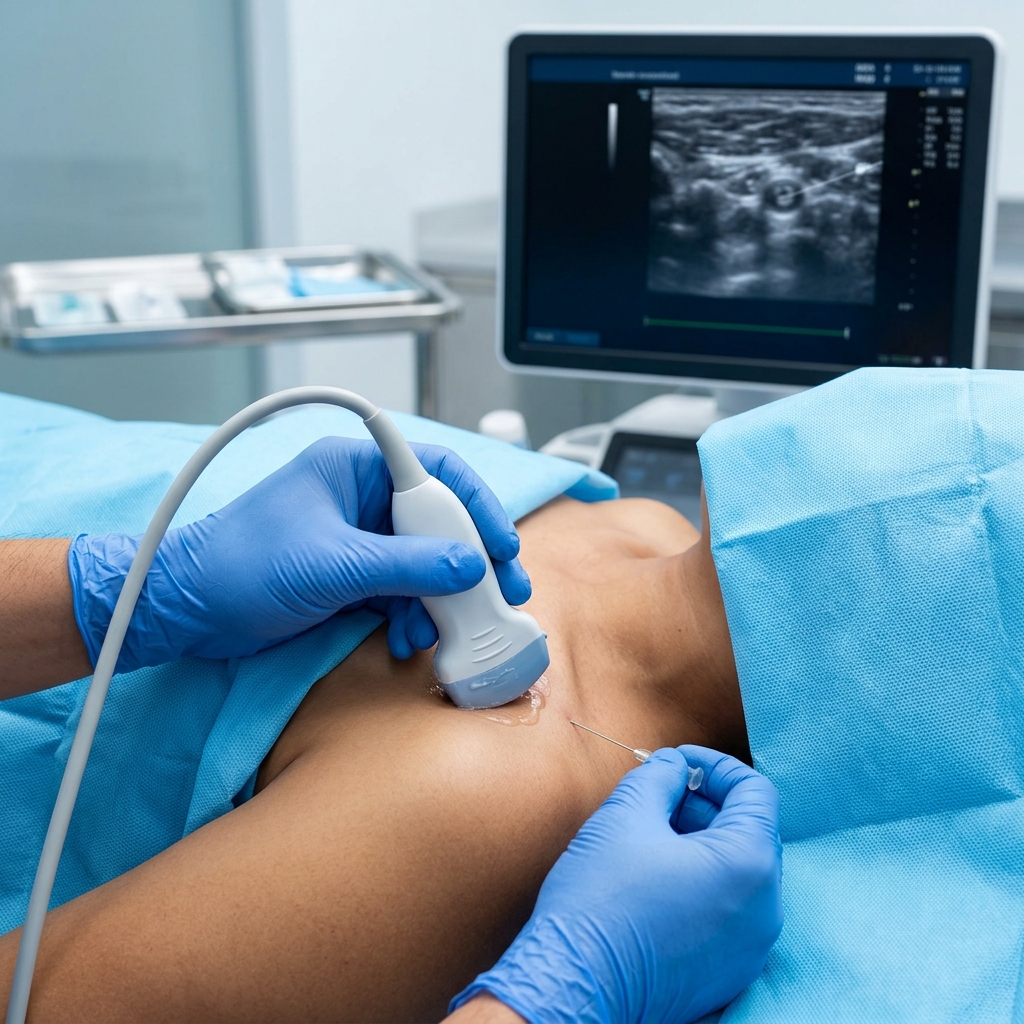
Flipping the Breaker Switch on Chronic Agony
Nerve pain is not like a standard muscle ache. It is an electrical malfunction. When a nerve is compressed by a tight muscle, entrapped by scar tissue, or inflamed by arthritis, it sends a constant, surging signal of 'burning' or 'shooting' pain directly to your brain. The standard medical response is to prescribe heavy oral nerve medications (like Gabapentin or Pregabalin). The problem? These pills are systemic. They medicate your entire body, leaving you feeling dizzy, groggy, and mentally trapped in a 'brain fog,' while the pain often still breaks through.
Why medicate your entire brain to fix a single, faulty nerve in your knee or pelvis? A Peripheral Nerve Block is the ultimate targeted solution. Imagine the painful nerve as a faulty electrical wire. Dr. Rabara uses ultrasound to find that exact wire and injects a specialized numbing medication directly around it. We go straight to the circuit breaker and flip the switch, instantly interrupting the pain signal before it ever reaches your brain.
Nerve Pathologies We Target
Is a Nerve Block Right for You?
The 100% Diagnostic Guarantee
A nerve block is unique because it serves two purposes instantly. It is Therapeutic (it provides long-lasting relief to help you heal) and it is Diagnostic (if the pain stops immediately after the injection, it proves with 100% certainty we found the exact nerve causing your misery).
You are an EXCELLENT candidate if:
- You describe your pain as "shooting," "burning," "electrical," or "stabbing."
- You are exhausted from taking oral pain pills that make you feel sleepy and unfocused.
- You are experiencing severe, localized pain after a recent surgery or trauma.
- Your pain is so severe that it prevents you from participating in physical therapy.
You may NOT be a candidate if:
- You have an active, systemic infection or a localized skin infection.
- You have an uncontrolled bleeding disorder.
The Realities of Nerve Blocks
While highly safe and incredibly effective, a nerve block is a medical procedure that temporarily alters your neurology. We want you fully prepared for the experience:
- Temporary Motor Weakness: Your arm or leg may feel temporarily "heavy," weak, or entirely numb for several hours. You must have a family member drive you home.
- The "Wear-Off" Period: Local anesthetic wears off in 6-12 hours. Steroids may take 2-3 days for the long-term effect to "kick in."
- Window of Opportunity, Not a Cure: The block turns off the pain so you can move again. We must use this window to perform targeted physical therapy.
Why Precision Matters for Nerve Pain
Systemic therapy. To dull the pain in your leg, you must dull your entire brain. Causes severe drowsiness and fog.
High-definition precision to see the exact nerve and deliver medication precisely around it.
Injected into a general area based on feeling the skin. Nerves are tiny; blind shots frequently miss.
The 3 Phases of Breaking the Pain Cycle
Immediate "Off-Switch"
Profound numbness and pain relief. Your limb may feel heavy. We strongly advise going home and resting.
The Reset Phase
Initial numbness wears off. Anti-inflammatory steroids begin working deeply to calm chronic nerve irritation.
The "Pain-Free" Window
The chronic cycle is broken. Your nervous system has relaxed, allowing for sleep and advanced physical rehabilitation.
Clinical Science & Technical Details
For our medical colleagues and highly analytical patients, we provide these transparent technical details on the pathophysiology and interventional protocols.
Explore the Clinical Science: Voltage-Gated Channels and Signal Interruption
The pathophysiology of peripheral neuralgia involves ectopic discharges from damaged or compressed nerve fibers. When a nerve undergoes chronic mechanical compression or chemical irritation, there is a pathological upregulation of voltage-gated sodium channels along the axonal membrane. This leads to spontaneous depolarization and the transmission of severe nociceptive signals via A-delta and unmyelinated C-fibers.
A Peripheral Nerve Block pharmacologically interrupts this neurophysiological loop. By utilizing high-resolution ultrasound to bathe the perineural space in a local anesthetic (such as Bupivacaine or Ropivacaine), we chemically bind the intracellular portion of these sodium channels. This completely blocks sodium influx, arresting the action potential and instantly halting the afferent pain transmission. Furthermore, the addition of a localized corticosteroid acts to downregulate pro-inflammatory cytokines, stabilizing the nerve membrane and providing long-term therapeutic relief long after the anesthetic has metabolized.
Detailed Diagnostic Pathways: Radiculopathy vs. Peripheral Entrapment
Accurate clinical management of neuropathic pain in Vigan City requires distinguishing between central radiculopathy and peripheral entrapment. For example, a patient presenting with "sciatica" may have a herniated lumbar disc compressing the L5 nerve root (central), or they may have severe spasm of the piriformis muscle compressing the sciatic nerve deep in the gluteal compartment (peripheral).
Dr. Rabara utilizes rigorous physiatric evaluation, provocative physical testing, and Diagnostic MSK Ultrasound to identify the exact site of mechanical compression. A nerve block serves as the definitive diagnostic tool. If a patient with severe pelvic floor and perineal pain receives an ultrasound-guided Pudendal Nerve Block at the ischial spine and experiences 100% immediate pain relief, we have definitively isolated the pudendal nerve as the primary pain generator.
Advanced Systemic Screening and Coagulopathy Guidelines
Patient safety is paramount during perineural interventions. While peripheral nerve blocks are minimally invasive, they carry inherent risks regarding vascular puncture and hematoma formation, particularly in deep, non-compressible spaces (such as the pudendal or sciatic nerve blocks).
Dr. Rabara adheres strictly to international regional anesthesia guidelines regarding coagulopathy and anticoagulant medications. Depending on the depth and vascularity of the targeted nerve, these medications may need to be temporarily held prior to the procedure, in strict coordination with the patient's primary cardiologist.
Pharmacokinetics and Local Anesthetic Systemic Toxicity (LAST)
The primary risk during the administration of localized anesthetics is unintentional intravascular injection, which can lead to Local Anesthetic Systemic Toxicity (LAST)—a potentially life-threatening complication characterized by central nervous system excitation followed by cardiovascular collapse.
At TeraCare, the utilization of real-time Diagnostic MSK Ultrasound virtually eliminates this risk. By utilizing color Doppler imaging prior to needle advancement, Dr. Rabara identifies and maps all adjacent vascular structures to ensure a safe needle trajectory. We visually confirm the spread of the anechoic fluid strictly within the fascial plane (hydrodissection), preventing intraneural or intravascular injection.
Inside the Procedure: The Mechanics of Perineural Hydrodissection
The clinical objective of an ultrasound-guided nerve block extends beyond mere pharmacological blockade; it provides a profound mechanical intervention known as Perineural Hydrodissection. Nerves frequently become entrapped and chemically irritated as they pass through narrow fibrososseous tunnels (e.g., the carpal tunnel).
During the procedure, Dr. Rabara introduces a large volume of injectate precisely into the fascial plane surrounding the epineurium. This anechoic fluid acts as a liquid wedge, physically separating the nerve from the constricting fibrotic tissue. This mechanical un-tethering restores the normal physiological glide of the nerve, immediately restoring intraneural microvascular blood flow.
Reversing Central Sensitization and The Wind-Up Phenomenon
When suffering from chronic peripheral neuralgia, the central nervous system undergoes pathological neuroplastic changes known as Central Sensitization. The spinal cord neurons become hyper-excitable, perceiving even light touch as agonizing pain (Allodynia).
A successfully implemented Peripheral Nerve Block completely severs the afferent barrage of nociceptive signals for a sustained period. This period of neurological "silence" allows the central nervous system to reset, frequently resulting in a permanent reduction of pain intensity.
The Blueprint for Immediate Relief
Ultrasound Nerve Mapping
Dr. Rabara uses live diagnostic ultrasound to look deep into your tissue, safely mapping the exact path of the painful nerve before the procedure begins.
Precision Hydrodissection
While watching the screen, Dr. Rabara guides an ultra-thin needle directly next to the nerve. We gently inject the fluid, which physically washes over the nerve, immediately numbing and un-sticking it.
Functional Rehabilitation
As the pain immediately drops to zero, we seamlessly transition you to our physical therapy team to safely stretch and strengthen the area while you are comfortable.
Common Questions
Does a nerve block injection hurt?
The procedure is highly tolerable. Nerves are sensitive, so you may feel a brief 'zing' or a sudden recreation of your usual pain for one second as the medicine washes over the nerve. However, this is immediately followed by profound, soothing numbness. We use local anesthetics to completely numb the skin before the procedure begins.
How long will the pain relief last?
This is highly variable. The immediate numbness lasts up to 12 hours. The long-term relief can last anywhere from several weeks to several months, depending on the severity of the nerve entrapment. In many cases, if the block allows you to successfully complete physical therapy, the pain may never return.
What if the nerve block only works for a few days and the pain comes back?
This provides us with incredible diagnostic data! If the block works perfectly but wears off quickly, it proves beyond a doubt that we found the exact pain generator. Dr. Rabara can then discuss advanced, longer-lasting interventions, such as Radiofrequency Ablation (using heat to temporarily deactivate the nerve) or Medical Botox to permanently relax the muscle crushing the nerve.
Is an ultrasound-guided nerve block covered by PhilHealth or my HMO?
Yes, because this is a highly specialized medical procedure designed to treat a diagnosed pain pathology, peripheral nerve blocks are frequently eligible for coverage under PhilHealth and many major HMO packages. Our clinic will assist you in verifying your benefits.
Can I drive myself home after the procedure?
No. Depending on which nerve is blocked, your arm or leg may temporarily lose its motor function (it will feel weak or heavy). You must have a designated driver or family member take you home safely after your appointment.