Decompress the Disc. Free the Nerve. Avoid the Scalpel.
Before you accept the risks of irreversible spine surgery, explore the anti-gravity solution. We utilize computer-controlled Mechanical Spinal Traction to safely pull bulging discs back into place.
Message Us to Book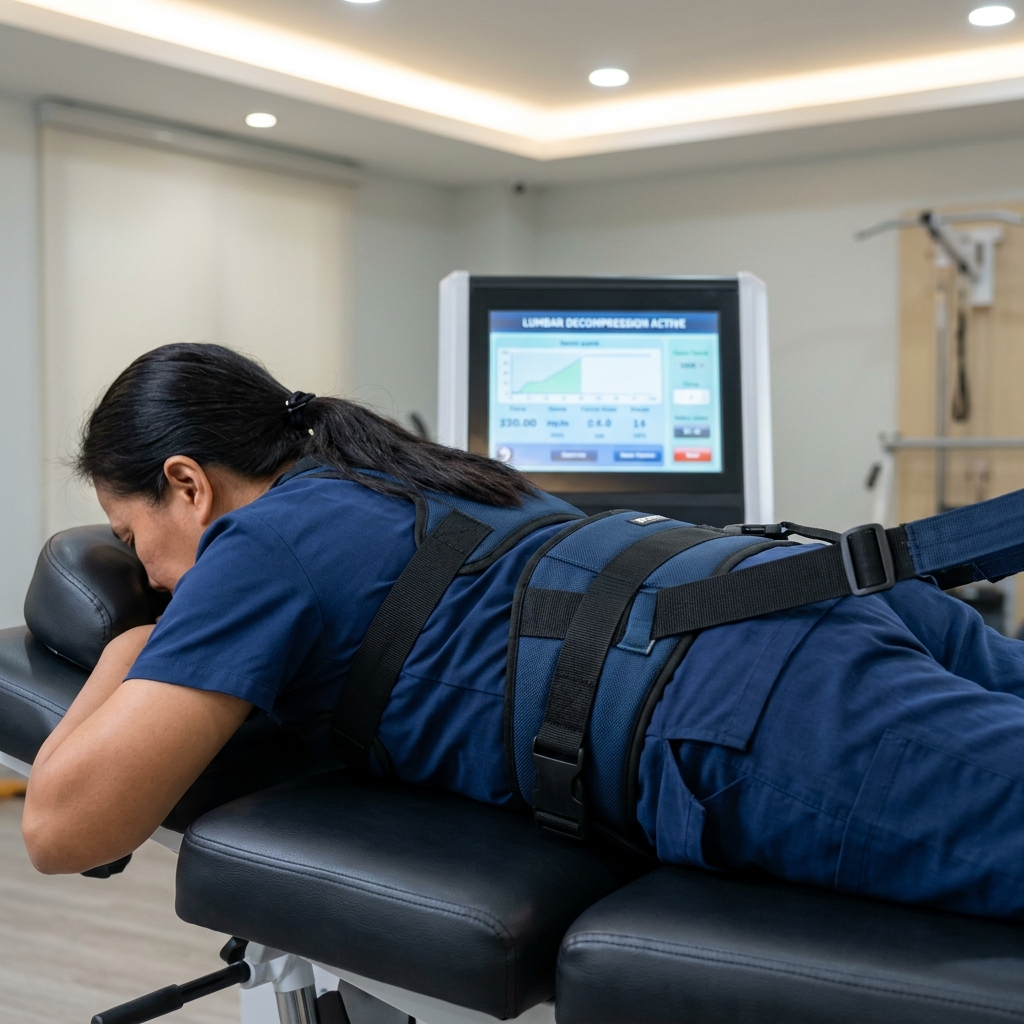
The Science of the Vacuum Effect
For years, gravity, heavy lifting, and poor desk posture have been silently compressing your spine. Your spinal discs are essentially the shock absorbers of your back, functioning much like jelly donuts. When the spine is subjected to too much compressive force, the 'donut' gets crushed, and the inner jelly bulges out. This bulging disc presses directly against your highly sensitive spinal nerves, causing sharp electricity shooting down your leg (sciatica), numbness in your feet, or a burning sensation down your arm.
Practitioner's Insight: When treating local patients for severe slipped discs, we do not rely on passive bed rest or aggressive manual pulling. Mechanical Spinal Traction is an engineering marvel designed to fight gravity. By securing you to a specialized table, we program a computer to apply a highly exact, microscopic pulling force. This gentle separation creates a vacuum effect that actively sucks the bulging jelly back into the center of the disc, instantly freeing the trapped nerve and allowing nutrients to heal.
Spinal Pathologies We Decompress
Is Spinal Decompression Therapy Right for You?
The Anti-Surgical Alternative
In our clinical experience in Ilocos Sur, we frequently consult with patients who have been told surgery is their only option. We reserve this advanced table for patients who want to exhaust every non-invasive avenue before agreeing to spinal fusion.
You are an EXCELLENT candidate if:
- You have been diagnosed with a slipped disc and want to avoid surgery.
- You suffer from 'ipit na ugat' causing severe shooting pain or numbness.
- You have chronic back pain that feels better when you hang or stretch, but returns.
- You have degenerative disc disease and need to rehydrate compressed discs.
You may NOT be a candidate if:
- You have severe spinal instability (Grade 2 Spondylolisthesis or higher).
- You have severe osteoporosis, spinal fractures, or active bone tumors.
- You have surgical hardware (plates/screws) from a previous spinal fusion.
- You are currently pregnant (lumbar traction is strictly contraindicated).
The Realities of Decompression
The idea of being 'stretched' can be intimidating. We want to eliminate your fear by explaining the safety mechanisms of our computer-controlled technology:
- It Does Not Hurt: The pulling force is slow and gentle. Most patients find the sensation of having pressure lifted so relieving that they often fall asleep during the 20-minute session.
- No Sudden Movements: The machine ramps up tension gradually. You are also given a safety kill-switch to hold; pressing it instantly and gently releases the tension.
- Post-Traction Muscle Fatigue: After the session, your spine has been elongated. Your stabilizing muscles may feel slightly fatigued later that evening as they adjust to the new alignment.
Why Computer Precision Matters
Cutting away the disc and using metal screws to fuse vertebrae. Requires months of painful rehab and permanently destroys mobility.
A computer applies a precise, calculated pulling force directly to the affected segment. Safely targets the disc without straining joints.
Hanging upside down. Lacks calibration, puts immense pressure on ankles/blood vessels, and can be dangerous for blood pressure.
The Timeline to a Healed Disc
Immediate Relief
Sharp drop in radiating nerve pain (sciatica). Numbness begins to retreat back toward the spine (centralization).
The Healing Phase
Cumulative decompression allows the tough outer fibers of the disc to permanently scar over and heal as the disc rehydrates.
Core Armor
We transition you into specialized PT to build an 'armor' of deep core strength to protect your spine from future compression.
Clinical Science & Technical Details
For our medical colleagues and highly analytical patients, we provide these transparent technical details on the pathophysiology and interventional protocols.
Explore the Clinical Science: Intra-Discal Pressure and Fluid Imbibition
Mechanical Spinal Traction manipulates intra-discal pressure drop from dangerously high levels to negative values (e.g., -100 mmHg to -150 mmHg).
This centripetal force physically retracts the herniated nucleus pulposus and facilitates fluid imbibition—drawing water, oxygen, and nutrients into the avascular disc matrix.
Detailed Diagnostic Pathways: Cervical vs. Lumbar Traction Angles
Treating a C5-C6 neck herniation requires approximately 15 to 20 degrees of flexion to optimally open the intervertebral foramen.
For lumbar traction, we manipulate the angular force to bypass paraspinal muscles and target the exact compromised disc space based on your MRI or diagnostic findings.
Advanced Systemic Screening: Cauda Equina Syndrome
Dr. Rabara mandates strict screening to rule out 'Cauda Equina Syndrome'—a massive central herniation that is a surgical emergency.
If you experience saddle anesthesia or sudden loss of bowel/bladder control, traction is strictly contraindicated and immediate surgical intervention is required.
Managing the Muscle Guarding Reflex
Our computerized tables eliminate involuntary muscle spasms (guarding) via algorithmic biofeedback. The force is applied in micro-increments.
If resistance is detected, the machine pauses, allowing the paraspinal muscles to 'surrender' so the pull acts purely on the intervertebral disc.
Inside the Procedure: Static vs. Intermittent Distraction Protocols
Static Traction (continuous pull) is preferred for acute radiculopathies. Intermittent Traction (rhythmic cycles) is superior for chronic Degenerative Disc Disease.
The alternating 'pumping' mechanism maximizes nutrient exchange within the avascular disc fibers, promoting long-term rejuvenation.
The Phenomenon of Centralization
A critical prognostic indicator is 'Centralization'—when radiating limb pain retreats proximally toward the spine. This indicates the herniated material is successfully migrating back.
Even if localized back pain temporarily increases as pain retreats from the leg or arm, it signifies that the neurological compromise is actively resolving.
Your Decompression Session
Harnessing & Positioning
Depending on your condition (neck or back), we fit you with a padded harness and position you on the state-of-the-art decompression table.
The Vacuum Cycles
The machine initiates slow, alternating cycles of gentle pulling and partial release. This 'pumping' action sucks fluid and nutrients into the disc.
Stabilization
After the 15-30 minute session, you rest for a few moments so your muscles can adjust before supporting your newly decompressed spine.
Common Questions
Gamot sa slipped disc ba ang spinal traction?
Yes, Mechanical Traction is one of the most effective non-surgical treatments for a slipped disc. It treats the mechanical root cause by using negative pressure to suck the bulging disc back into place.
Does spinal decompression therapy work, or is it a gimmick?
It is highly effective and backed by orthopedic science. It works by applying the laws of physics (distraction and negative pressure) to human anatomy. However, it requires a thorough medical diagnosis first.
How many sessions will I need?
A standard protocol typically requires 12 to 20 sessions, performed 2-3 times a week, to ensure permanent disc retraction and tissue healing.
How much is the cost of spinal decompression in the Philippines?
At TeraCare in Vigan City, we bundle traction into transparent, physician-directed packages. Parts of your treatment may be eligible for HMO or PhilHealth coverage.
Chiropractor vs. Spinal Decompression: Which is better for an ipit na ugat?
If caused by a bulging disc, decompression is safer. It involves zero twisting or sudden thrusts, using only slow, linear separation to safely free the nerve.