Iron Out the Gristle. Break the Adhesions. Restore Smooth Movement.
When human hands are too broad and too soft to break down deep, chronic scar tissue, you need structural precision. We utilize advanced Instrument-Assisted Soft Tissue Mobilization (IASTM)—often recognized as muscle scraping or blading.
Message Us to Book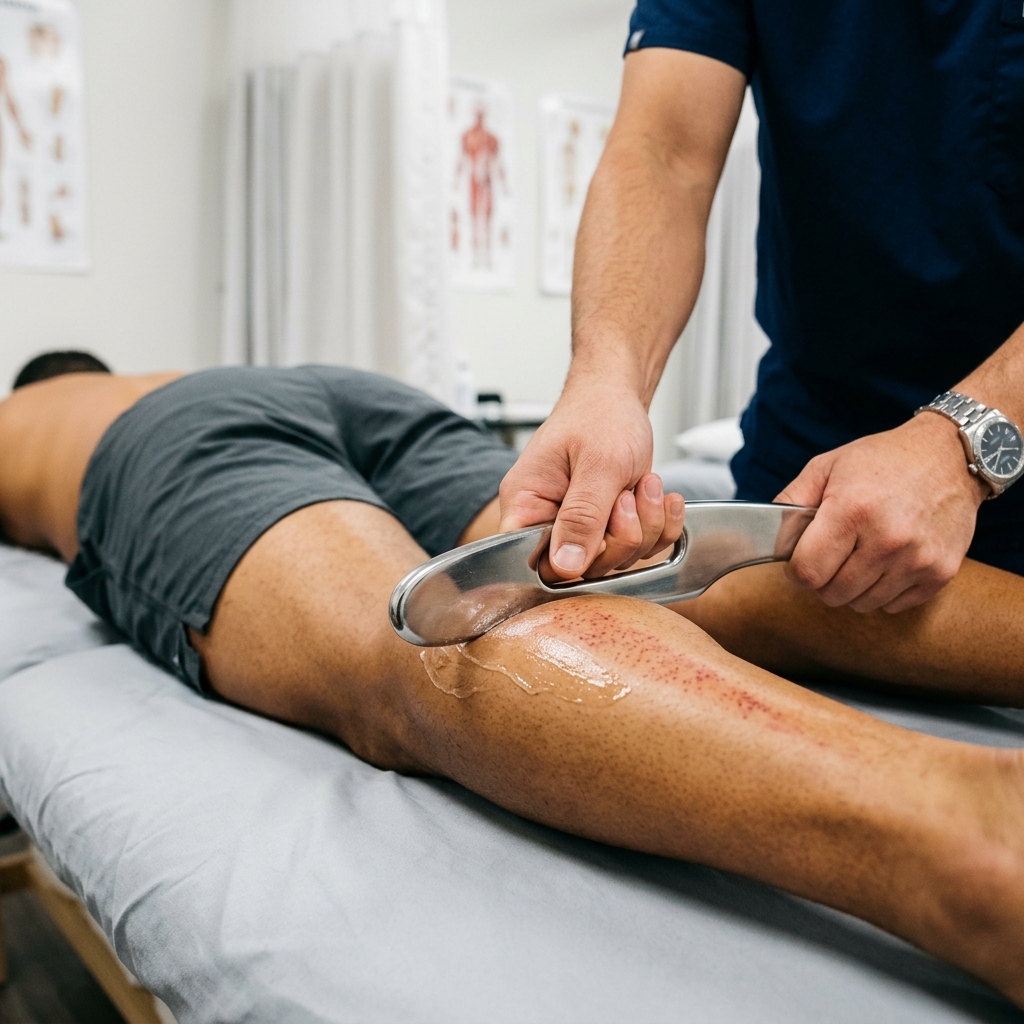
The Ironing Board for Your Muscles
If you have chronic tendonitis, a healed surgical scar, or a stubborn sports injury, you likely feel a mechanical 'catch' or a rough, grating sensation when you move. Your fascia—the connective tissue wrapping your muscles—has healed poorly. Instead of lying in smooth, organized lines, it has healed like a messy, tangled plate of spaghetti. Trying to break down this microscopic, leathery scar tissue with a traditional hands-on massage is like trying to iron a deeply wrinkled shirt while wearing boxing gloves.
Practitioner's Insight: When treating local patients for severe IT band friction or chronic tennis elbow in our Vigan City clinic, we bypass standard massage entirely. IASTM utilizes highly specialized, beveled stainless steel instruments. These tools act like a fine-toothed comb, allowing us to feel the exact millimeter where the tissue is restricted. As we glide the steel edge over the skin, we can precisely 'iron out' the tangled collagen fibers, forcing disorganized scar tissue to remodel into smooth, functional muscle.
The Adhesions We Break Down
Is Muscle Scraping Right for You?
The Solution for "Leathery" Tissue
In our clinical experience in Ilocos Sur, we find that athletes, post-operative patients, and manual laborers benefit the most from this structural intervention. We reserve this treatment for patients whose tissue feels mechanically "stuck."
You are an EXCELLENT candidate if:
- You feel a distinct "crunchy" or gristly sensation inside your tendon when you move.
- You have a thick, raised, or tight surgical scar that limits your joint mobility.
- You suffer from chronic, nagging sports injuries that standard rest and stretching cannot resolve.
- You want an aggressive, targeted physical therapy approach and are not afraid of a slightly intense manual treatment.
You may NOT be a candidate if:
- You are currently taking heavy prescription blood thinners or have a bleeding disorder.
- You have thin, fragile, or paper-like skin (advanced age or prolonged corticosteroid use).
- You have an active, open wound, a severe skin infection, or an unhealed fracture directly under the treatment zone.
The Realities of the "Crunch"
Muscle scraping therapy is highly tactile, interactive, and completely different from a standard massage. Here is exactly what you will experience:
- The Gristle and the Crunch: As we glide the steel instrument over your skin, you will literally feel and sometimes hear a rough, grating sensation. This is the exact sound of disorganized, leathery scar tissue being physically broken down. Many patients find this highly satisfying.
- Reframing the "Bruise" (Petechiae): The redness we generate is called petechiae. By aggressively scraping the dead scar tissue, we intentionally cause micro-trauma. This pulls trapped, stagnant blood to the surface and forces your body to rush fresh, oxygen-rich healing cells into a chronic area.
- Temporary Soreness: Just like an intense workout, breaking down old tissue causes soreness. You will likely feel a dull ache in the treated area for 24 to 48 hours. This is the biological cost of initiating a new healing cascade.
Why Steel Outperforms Traditional Tools
Using thumbs, palms, or elbows to compress tissue. The surface area is too wide to sharply isolate deep, microscopic fascial restrictions.
Precisely beveled, medical-grade stainless steel instruments. It amplifies tactile feedback, allowing the clinician to locate and iron out the exact millimeter of scar tissue.
Broad, blunt compression applied blindly. A foam roller cannot differentiate between healthy tissue and a fibrotic nodule.
The Timeline to Flawless Fascia
Immediate Mobility
When you stand up, the 'sticky' feeling in your muscle will be significantly reduced. You will experience a massive increase in local warmth and an immediate improvement in range of motion.
Remodeling Ache
The treated area will look red or speckled (petechiae) and will feel bruised to the touch. This is the crucial inflammatory phase where your body cleans out broken scar tissue.
The Smooth Glide
Series of 4 to 8 sessions. As progress continues, the 'crunchy' feeling disappears and the petechiae response lessens, indicating scar tissue has remodeled into smooth, parallel fascia.
Clinical Science & Technical Details
For our medical colleagues and highly analytical patients, we provide these transparent technical details on the pathophysiology and interventional protocols.
Explore the Clinical Science: Mechanotransduction and Fibroblast Proliferation
The biological efficacy of IASTM is driven by mechanotransduction. When the stainless steel instrument applies shear force across the fascial plane, it creates controlled micro-trauma to the disorganized collagen matrix.
This mechanical stress stimulates the proliferation of local fibroblasts, while the friction increases localized tissue temperature and alters the viscosity of hyaluronic acid, transitioning it from a restrictive gel to a lubricating fluid (fascial glide).
Detailed Diagnostic Pathways: Locating Fibrotic Nodules
At TeraCare, the IASTM tool is utilized as both a therapeutic intervention and a powerful diagnostic amplifier. The resonance of the instrument transmits vibrations directly into the clinician's hands.
When passing over fibrotic nodules or cross-linked adhesions, the clinician feels a distinct 'vibratory chatter' or 'crunching' sensation. This allows us to map the precise margins of the scar tissue lesion, ensuring force is applied exclusively to the pathological tissue.
Advanced Systemic Screening: Capillary Fragility and Anticoagulant Use
Because IASTM applies sheer force to reach deep fascia, capillary fragility is a primary clinical concern. Patients undergoing active anticoagulant therapy (Warfarin, Rivaroxaban) or high-dose NSAID regimens possess a diminished coagulation cascade.
Applying IASTM to these populations risks converting therapeutic petechiae into massive subcutaneous hematomas. A comprehensive review of the patient's pharmacological history is mandatory prior to initiating a protocol.
Managing Extravasation and the Inflammatory Cascade
The appearance of petechiae during IASTM is the visual manifestation of erythrocyte extravasation due to mechanical shear stress. This is a highly desired clinical endpoint that triggers a macrophage response.
The clinician must skillfully dose the treatment: aiming for moderate erythema (redness) to trigger the inflammatory cascade and Type I collagen synthesis, without over-treating to cause excessive ecchymosis (deep bruising) that would hinder rehab.
Inside the Procedure: Instrument Bevels and Treatment Vectors
Dr. Rabara's clinical team utilizes specific instruments depending on anatomical topography. For broad surfaces like the IT Band, a large handlebar tool assesses the entire kinetic chain.
For pinpoint pathologies like the lateral epicondyle, a small, sharply convex tool hooks directly under the bony prominence. Strokes are applied in a multi-directional star pattern—longitudinal, transversal, and diagonal—to break down the collagen lattice from every vector.
The Necessity of Eccentric Loading Post-Scraping
Breaking down scar tissue is only the first half of the equation; the body needs instructions on how to rebuild it. Post-treatment rehab mandates heavy eccentric loading (lengthening the muscle under tension).
Eccentric exercise applies mechanical stress along the longitudinal axis, physically signaling the newly active fibroblasts to lay down fresh collagen in perfectly parallel lines, ensuring the new tissue is strong and resistant to future tearing.
The Breakdown and Rebuild Process
Emollient & Diagnostic Sweeping
We apply a specialized, low-friction emollient to your skin. Using broad-edged tools, we perform diagnostic sweeps to actively 'feel' for the rough spots indicating hidden fascial adhesions.
The Targeted "Scrape"
Once scar tissue is located, we switch to a precisely beveled edge. We apply firm, directional shearing strokes. You will feel the 'crunch' as the tissue yields, and the skin will turn warm and red (petechiae).
Neuromuscular Re-education
The moment the adhesion is broken, your joint has new mobility. We immediately take you through active PT movements to force your brain to 'save' and utilize the newly restored, pain-free range.
Common Questions
Is muscle scraping painful?
It is intensely tactile, but it should not be excruciating. You will definitely feel a firm, scraping pressure, and the 'crunching' of the scar tissue can be uncomfortable for a few minutes. We aim for a 'good hurt'—the satisfying feeling of a deep restriction finally being released.
I see tools on Amazon. Can I just do this myself at home?
We strongly advise against aggressive DIY scraping. While light, superficial scraping (like a facial Gua Sha) is safe at home, applying heavy mechanical shearing force to your deep tendons requires extensive anatomical knowledge. If you scrape too hard or in the wrong direction, you can cause severe tissue damage or hematomas.
What is the difference between Graston Technique and IASTM?
They are functionally the same thing. 'Graston Technique' is simply a specific brand name of tools and a trademarked certification course. IASTM (Instrument-Assisted Soft Tissue Mobilization) is the universal medical term for the procedure.
How much does IASTM / Muscle Scraping cost in the Philippines?
IASTM is a highly specialized manual therapy technique. At TeraCare, we do not usually charge for it as a standalone service; it is seamlessly integrated into a comprehensive, physician-directed physical therapy plan.
Will the red marks stay on my skin forever?
No. The red speckling (petechiae) is a highly temporary, intentional therapeutic response. For most patients, the redness fades within 3 to 5 days, just like a minor hickey or the marks left behind by cupping therapy.