Restore Your Foundation. Walk Further. Fall Less.
Whether you are a stroke survivor battling 'foot drop' or as athlete protecting a torn ligament, generic sleeves will not save you. We provide custom-molded 'prescription biomechanics' that give you the structural stability to move with confidence again.
Message Us to Book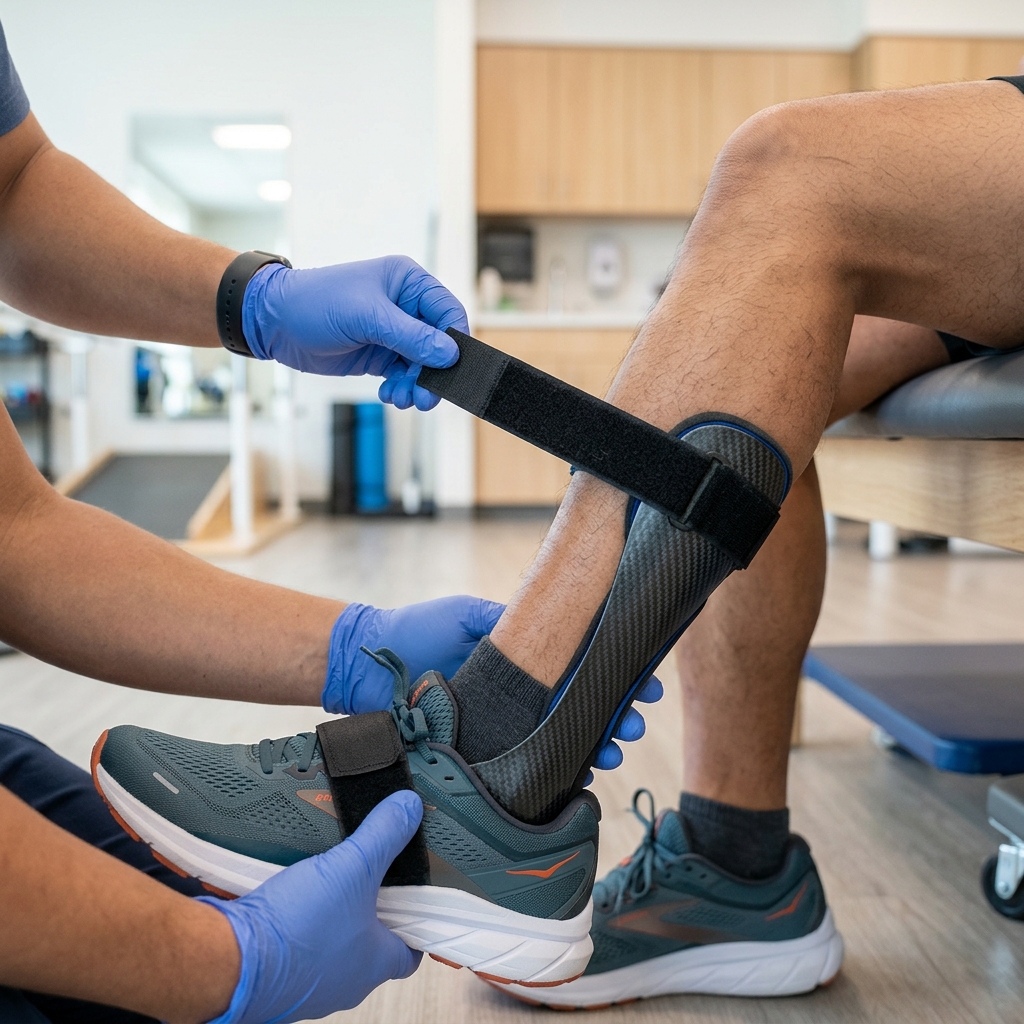
The Difference Between a 'Sleeve' and a Medical Device
When a joint gives out—due to a torn ligament, severe arthritis, or neurological nerve damage—your entire foundation is compromised. For stroke survivors, 'foot drop' means the toe constantly drags, turning every doorstep into a fall hazard. For orthopedic patients, an unstable knee creates a paralyzing fear that the joint will buckle and send you to the floor.
A stretchy neoprene sleeve from a pharmacy will not fix these structural deficits. You need 'Prescription Biomechanics.' At TeraCare, Dr. Rabara diagnoses the exact muscular or ligamentous failure in your limb. We then coordinate with elite certified orthotists to design a custom device—such as an Ankle-Foot Orthosis (AFO) or a rigid Knee Unloader—specifically tailored to your unique anatomical vectors.
Conditions Requiring Custom Extremity Bracing
Do You Need a Custom Medical Brace?
You are an EXCELLENT candidate if:
- You are a stroke survivor who constantly trips or falls due to foot drop.
- You have 'bone-on-bone' knee arthritis with sharp pain while walking.
- You have suffered a ligament tear and need an 'external skeleton' for stability.
- Your hand or wrist is curling inward due to spasticity or nerve damage.
You may NOT be a candidate if:
- You have a minor, temporary strain healing well with basic PT.
- Your joint pain is purely muscular and responds well to simple exercises.
- No structural ligamentous or neurological deficit is present.
The Realities of Wearing a Custom Orthosis
A custom brace is a structural shell that substitutes for lost muscle function. It requires physical and mental adaptation:
- Shoe Modifications: Rigid AFOs require supportive sneakers, often one to two sizes larger or wide-fit, to accommodate the device footprint.
- Adaptation Phase: You must build up wear-time slowly (the 'Break-in' period) to prevent skin blisters on paralyzed limbs with reduced sensation.
- Gait Re-Education: The brace is only half the fix. We use specialized PT to train your brain to stop compensatory habits like 'circumduction' (swinging the leg wide).
Sleeves vs. Medical Orthotics
Stretchy neoprene or fabric. Good for warmth or mild swelling, but will not stop a knee from buckling.
Physician-prescribed 3D scans ensure a total-contact fit that physically substitutes for lost ligament or muscle strength.
The Timeline to Mobility Independence
The Break-In Phase
Restricted wear schedule (1-2 hours) while checking the skin for redness. Caregivers are trained on proper 'donning and doffing'.
Gait Re-Training
Intensive therapy to eliminate 'limping' habits. The brain learns to trust the mechanical stability of the brace.
Functional Freedom
The brace becomes a natural extension of the body. Navigate stairs and uneven ground with drastically reduced fall risk.
Clinical Science & Technical Details
For our medical colleagues and highly analytical patients, we provide these transparent technical details on the pathophysiology and interventional protocols.
Explore the Clinical Science: Ground Reaction Forces & Joint Kinematics
In patients with peroneal nerve palsy or stroke, the loss of active tibialis anterior recruitment leads to 'foot drop' during the swing phase of gait. A custom AFO corrects this by manipulating the Ground Reaction Force (GRF).
By locking the ankle at a neutral 90-degree angle or utilizing dynamic carbon-fiber leaf springs, the device ensures toe clearance and stabilization during heel-strike, drastically reducing the energy expenditure of walking.
Detailed Diagnostic Pathways: Neuromuscular vs. Orthopedic Bracing
Physiatry-led bracing combines neuromuscular diagnostics with biomechanical correction. For stroke patients, we frequently pair Medical Botox (to reduce spasticity) with custom AFOs for maximum functional gain.
In orthopedic cases, such as ACL deficiency, we utilize hinged 4-point leverage systems to prevent anterior tibial translation, substituting for the lost internal ligamentous anchor.
Advanced Systemic Screening: Edema & Diabetic Foot Care
A successful fitting requires stable limb volume. We actively manage peripheral edema (swelling) before final scans are taken to ensure a total-contact fit. In diabetic patients, we also screen for neuropathy.
Because diabetic patients may not feel 'pressure points,' their orthotic must be meticulously rectified to avoid ischemia and pressure ulcers over the fibular head or navicular bone.
Clinical Biomechanics: Custom Unloader Leverage Systems
Unicompartmental knee osteoarthritis management utilizes a 3-point leverage system. A custom unloader brace is fabricated with a valgus or varus moment to pry open the collapsed medial or lateral joint compartment.
This mechanical 'offloading' alters the weight-bearing axis of the lower limb, reducing compressive forces on damaged cartilage and facilitating pain-free ambulation without narcotics.
Our Seamless VIP Orthotic Pathway
Gait & Joint Analysis
Dr. Rabara performs a clinical assessment to pinpoint the exact failure point (muscular, nerve, or ligament) in your limb movement.
Digital Orthotic Mapping
We coordinate with certified orthotists for 3D digital scanning or fiberglass casting to create a flawless positive model of your limb.
Functional Integration
Once the custom brace is fitted, we immediately transition you to task-specific PT to maximize your new mobility and safety.
Common Questions
Can I drive with a custom knee brace or AFO?
If the brace is on your right (driving) leg, a rigid AFO may block your ankle from pivoting safely between gas and brake. If it is on the left leg (automatic transmission), driving is usually safe once cleared by Dr. Rabara.
Will I have to wear this brace forever?
For traumatic ligament recovery, the brace is temporary. For permanent neurological deficits (like a severe stroke), it becomes a vital long-term tool for daily safety and mobility.
How do I clean my custom brace?
Most custom thermoplastic braces can be wiped down with a damp cloth and mild soap. Foam liners should be air-dried to prevent odor and bacterial buildup.
Is it covered by PhilHealth or standard HMOs?
Yes. Because custom orthotics are prescribed for documented medical deficits (stroke, arthritis), they are frequently eligible for Durable Medical Equipment (DME) coverage.
Will a knee brace cure my arthritis?
It cannot regrow cartilage, but a custom 'Unloader' brace physically pries open the collapsed joint space, eliminating 'bone-on-bone' grinding and delaying surgery for years.